AI for Personalized Content Recommendations
Advanced ML Recommendation System • July 2024 - Apr 2025
Introduction Video
For a detailed overview, please watch the introduction video above, which showcases the system's features and user experience.
Project Overview
This project was undertaken as my Final Year Project (FYP) at the Hong Kong University of Science and Technology (HKUST) in 2024-25. The goal was to design and implement an advanced recommendation system capable of suggesting local businesses—such as restaurants, cafes, retail stores, and service providers—to Yelp users based on their preferences and behaviors.
Unlike traditional recommendation systems, this solution was built to handle real-world complexities inherent in the Yelp dataset, which contains millions of user reviews, ratings, and business metadata. The system adopts a multi-stage architecture, integrating retrieval and ranking phases to ensure both scalability and precision.
Technology Stack & My Role
Technologies Used
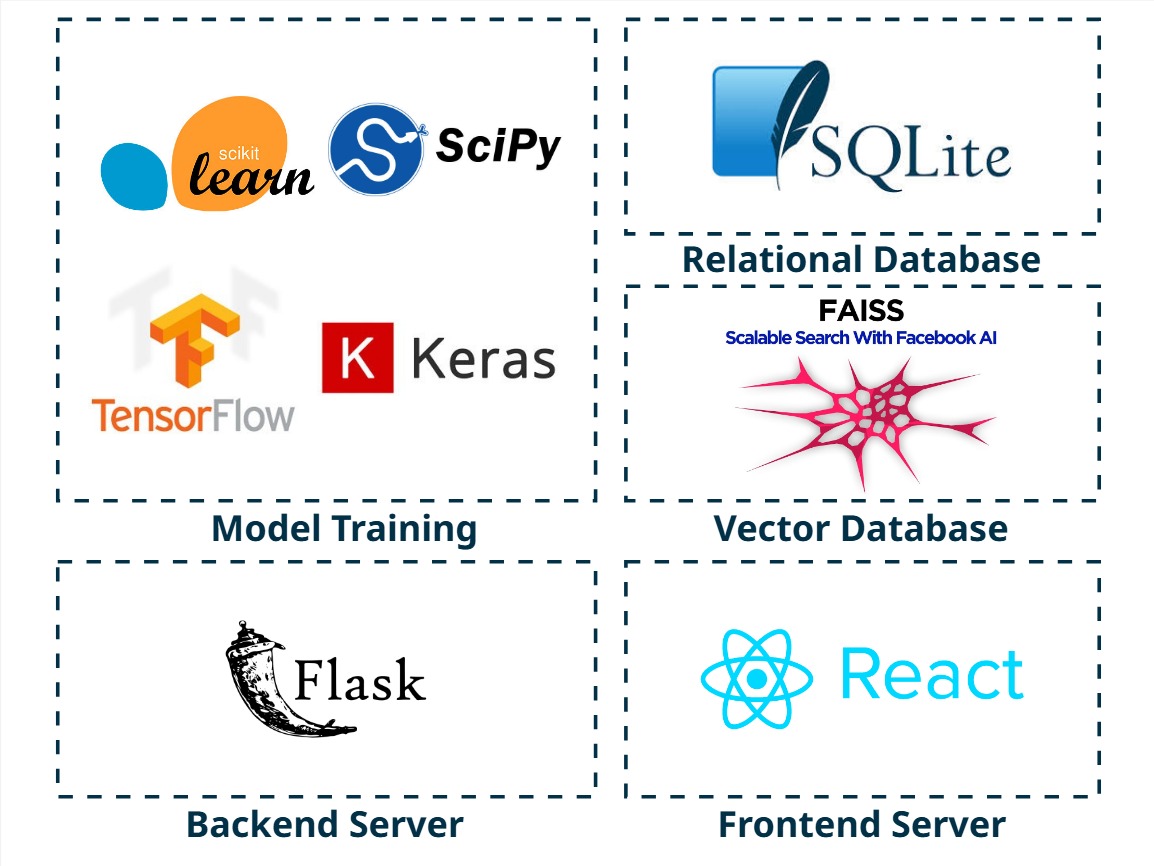
My Role
- System Design & Integration - Architected multi-stage pipeline
- Frontend Development - React-based web application
- Documentation - 40-page final report and visualizations
Significance of the Project
Recommendation systems are at the heart of modern digital platforms, driving user engagement and business growth. This project stands out due to its focus on addressing three pervasive challenges in recommendation systems:
Data Sparsity
With a sparsity rate of 99.99% in the Yelp dataset, traditional methods struggle to generate meaningful recommendations.
Cold-Start Problem
New users or businesses with limited interaction histories pose a significant hurdle for personalization.
Long-Tail Biases
Popular businesses tend to dominate recommendations, leaving niche or less-reviewed options underexposed.
Methodology
The recommendation system is designed as a two-stage pipeline: Retrieval and Ranking. This modular approach ensures scalability (handling millions of candidates) and precision (delivering top-quality suggestions).
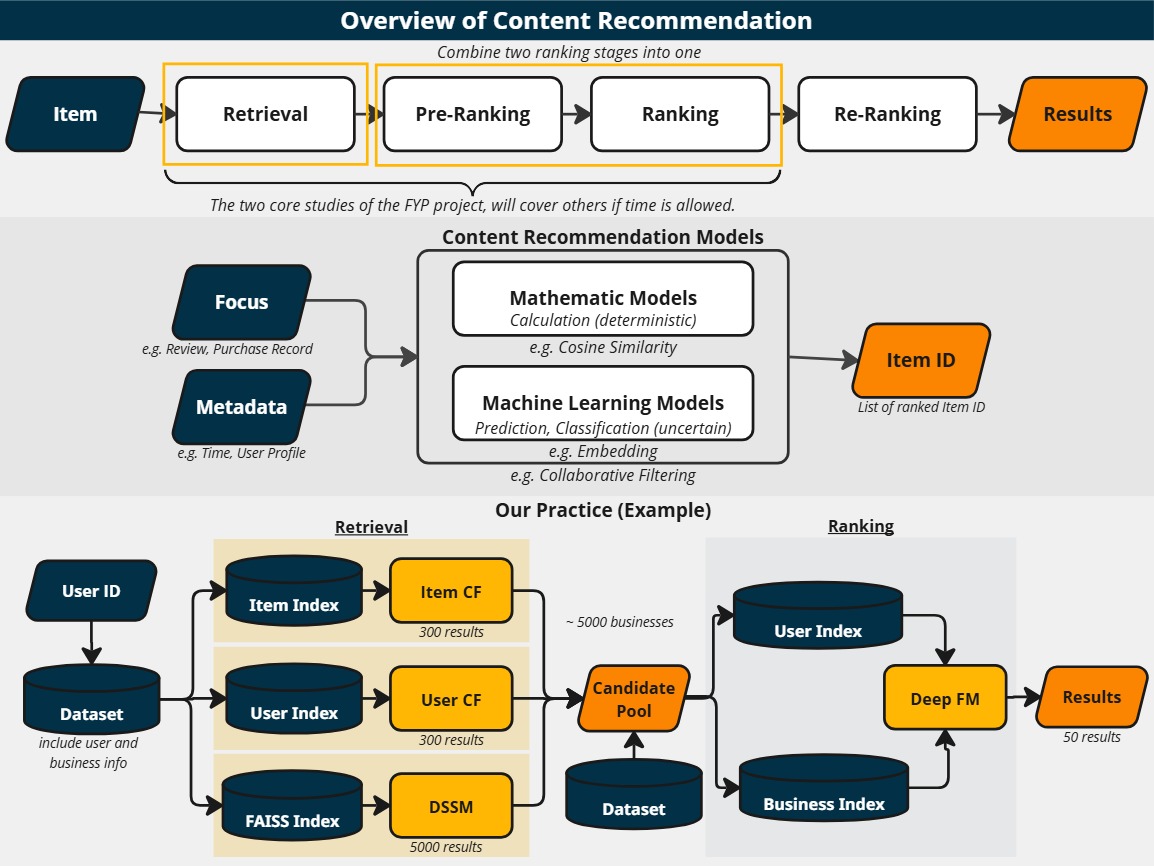
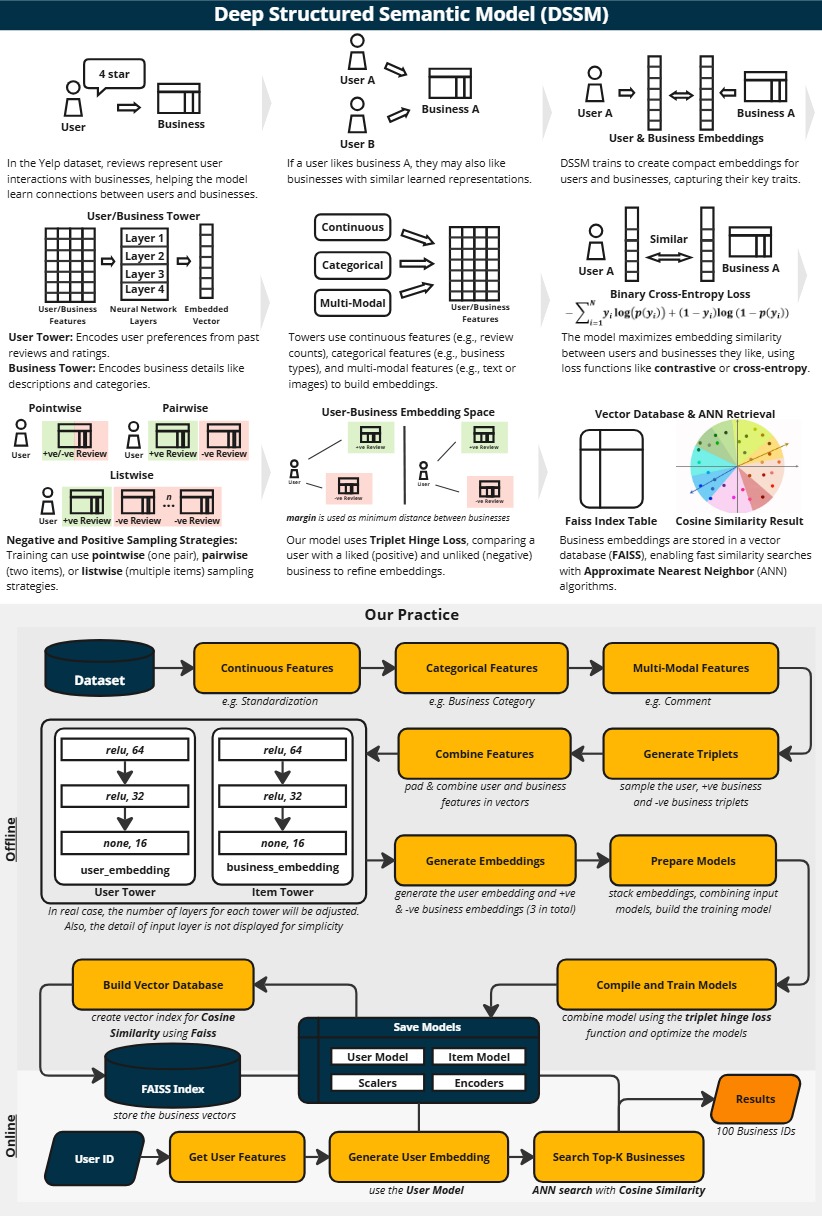
The system implements various recommendation models. For instance, the Deep Structured Semantic Model (DSSM) used in the retrieval stage is a deep learning framework that maps users and businesses into a shared latent space, capturing semantic relationships and improving retrieval accuracy even in sparse datasets.
Demo Application
To demonstrate the system's practical utility, I developed a web application deployed on AWS for scalability and reliability.
Key Features
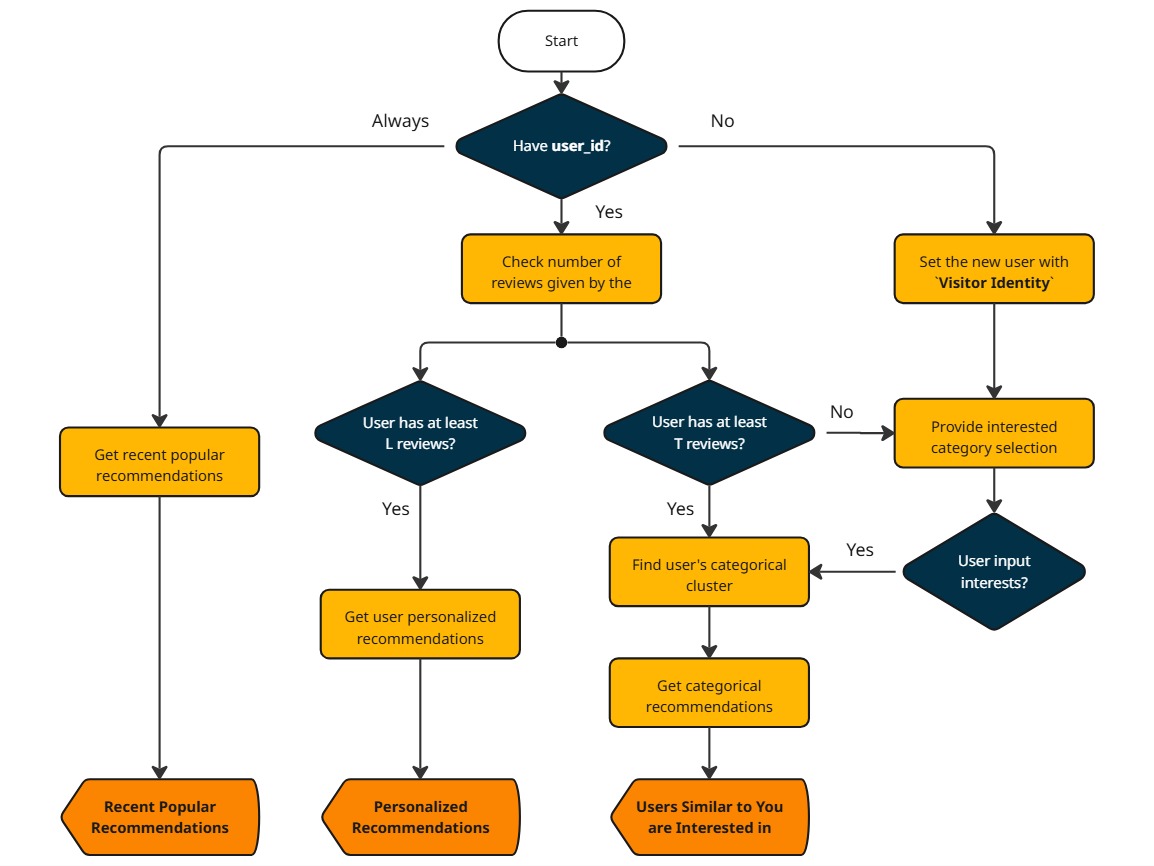
- Personalized Recommendations - Users with sufficient review history receive tailored suggestions
- Fallback Options - New or sparse users are shown recent popular items or category-based picks
- Interactive Interface - Built with React.js, featuring a clean dashboard and real-time suggestion updates
User Journey
My Contributions
As a core member of the three-person team, I played a pivotal role in shaping the project. My responsibilities included:
System Design & Integration
- Architected the multi-stage pipeline, ensuring seamless interaction between retrieval and ranking components
- Integrated diverse models (CF, DSSM, Deep FM) into a cohesive system using Python and TensorFlow
Frontend Development
- Designed and implemented the React-based web app, focusing on responsiveness and user experience
- Connected the frontend to a Flask backend with SQLite for data management
Report Writing & Documentation
- Authored a 40-page final report detailing methodology, results, and analyses
- Created visualizations (e.g., architecture diagrams, performance plots) to communicate findings effectively
Future Work
Looking ahead, I plan to:
- Incorporate real-time user feedback to refine recommendations dynamically
- Experiment with reinforcement learning to optimize long-term user engagement
- Scale the system to handle larger datasets, such as Yelp's full historical data
Repository & Documentation
License
This project is licensed under the MIT License.